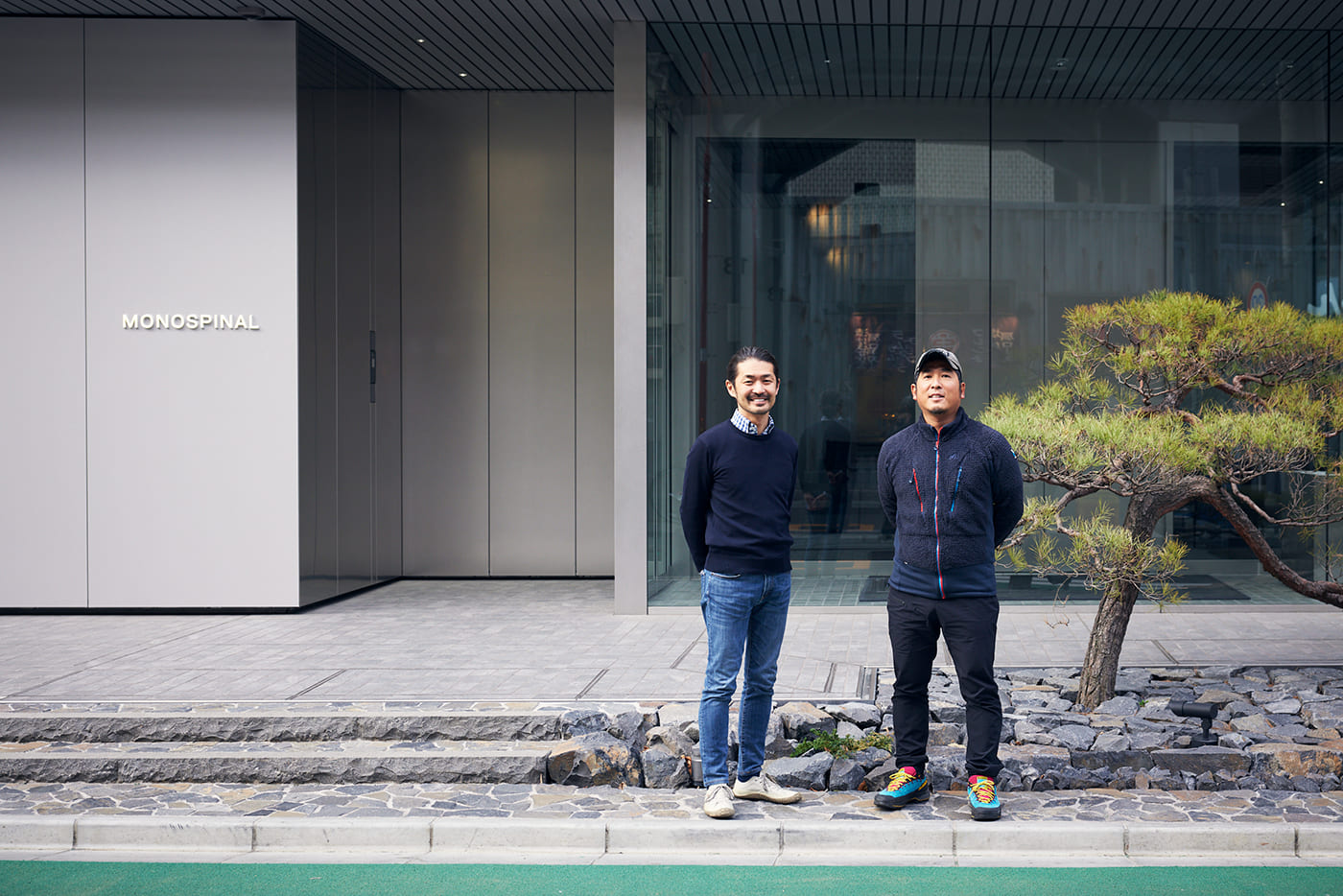
MONOSPINAL, an office building for a game production company, emerged in 2023 in Asakusabashi, Tokyo. The architecture designed by Makoto Yamaguchi is surrounded by nine layers of sloping walls, making it impossible for passers-by to get a glimpse of the interior. All facilities, including security, are centrally controlled by a tablet PC. The inverted-slope walls that open up to the sky control the sound, light, and wind from the densely populated surroundings with an elevated railway and multi-tenant buildings to offer an environment where the users could concentrate on their creations.
In Shakkei—Neighbouring Textures, we have been visiting Japanese gardens. This time, with MONOSPINAL as the subject, we will discuss the experiments of creating new sceneries by incorporating Japanese cultural sensibilities.
Interviewer/writer: Yoko Kawamura
Photographer (portraits): Misaki Yanagihara
A facade offering no informati
So, what was it like photographing the MONOSPINAL?
Kumon: There are many things to focus on. I took many photographs of the same places, but the thinking behind each time was quite different. For example, this exterior wall can look dramatically different just by moving the camera slightly to the left or right. Naturally, the texture of the color also changes according to the time of the day. When the yellow color fades, the tone is cooler. In the evening, it becomes a little more emotional. I struggled with such interpretation in printing.
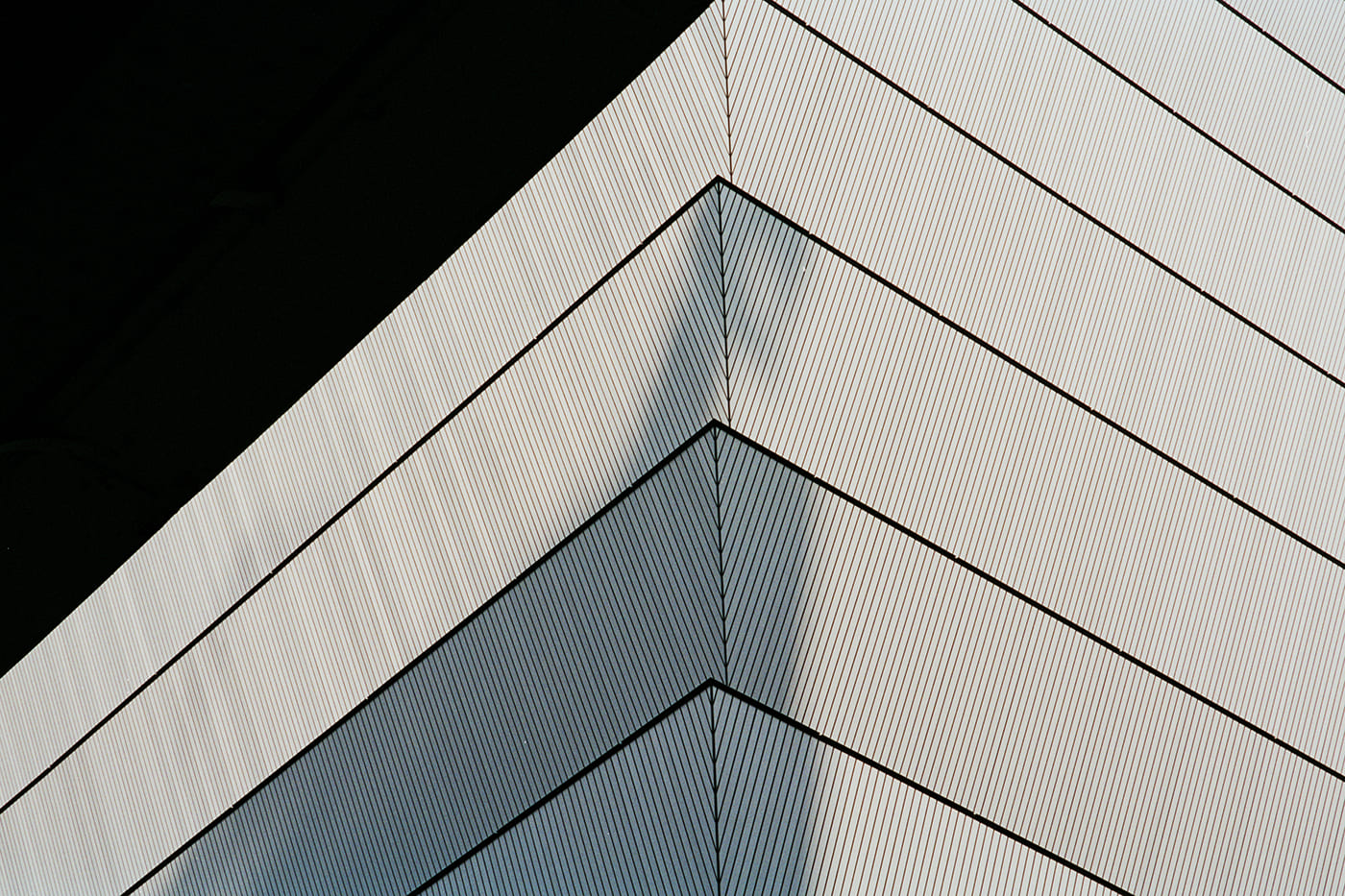

I see that is how much influence from the outside world can reflect on architecture.
Kumon: That’s right. You can’t get the full picture by looking from below, but it still does have an impact. At first, I was worried about how to photograph it; but once I had started, it was fun.
Yamaguchi: The building is a combination of multiple materials, including aluminum panels and glass. However, I was surprised at the various expressions discovered through how Mr. Kumon captured them. I think that is precisely how I wish this building was viewed.
Kumon: It wouldn’t have turned out like this if it was before we started the Shakkei—Neighbouring Textures project. This is actually the first photo I took. The moment I saw this, I thought the electric wires looked cool. When I realized I was feeling that way in this session about what we conventionally would want to exclude, such as electric wires, I knew I could photograph them in any way possible and succeed.
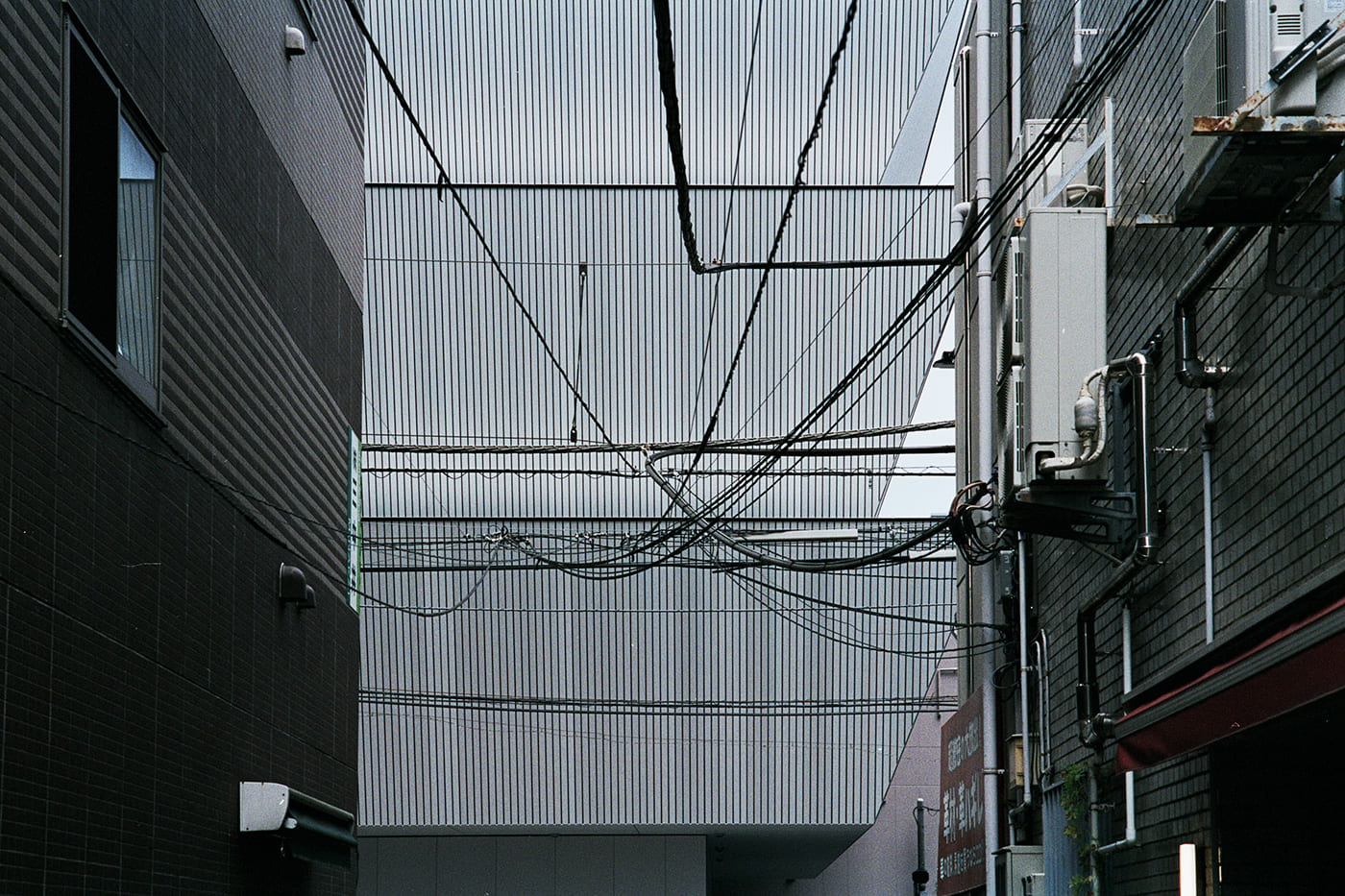
Yamaguchi: There are many places in Asakusabashi where electric wires are tangled like this. With the elevated railway in its front, I think this photo symbolizes the unique image of this crowded town.
Kumon: Rather than putting MONOSPINAL in the center, I tried to photograph it as part of the landscape. That is when I discovered once again that there are no straight lines in nature. The horizon is not a straight line, nor can you find one in human bodies. So, when I thought about where I could find a straight line, I could only imagine gravity, like an apple falling, though I’m not an expert on anything. Electric wires would naturally droop, and shadows of buildings tend to fluctuate.
Yamaguchi: That’s true. So many electricity poles are also slanted.
Kumon: Exactly. That’s why I thought MONOSPINAL, which consists solely of straight lines, would become a symbol in a town full of curves.
Yamaguchi: I see. When we hear the term “symbol,” we generally imagine something symbolic, like a landmark. However, in this case, we can’t see what’s happening inside, which gives this tranquil impression in the sense that it doesn’t provide any information. I designed it hoping it would become part of the landscape, so I feel like that may have worked.
Kumon: Although, when I first saw it, I was struck by its presence (laughs).
When you previously photographed the Hama-rikyu Gardens , I remember the photo of a one-story building in a Japanese garden set against the backdrop of a forest of modern buildings. Trimming the signboard at the top of the building made it less descriptive, which gave the architecture a certain sense of abstraction, resulting in a photograph where both the garden and the modern buildings are the main subjects. I believe what you realized at the time is relevant to what you said earlier; to what extent did you intend to “not offer information”?
Yamaguchi: In this case, that was the most crucial part of designing the exterior. I thought a part of the reason that sceneries don’t emerge around buildings is because we can tell what they are for. Office buildings would have their company names written on signboards. But because this building doesn’t have one, it looks like a sculpture that we don’t know what it is for. In other words, the meaning disappears to the outside world.
I think another key is its monotonous nature. Basically, it is a repetition from the bottom to the top. It traces the law of nature where a trunk grows into branches and then comes leaves. The exterior walls are made by stacking thin aluminum panels with a finishing process called shot blasting, where tiny iron shots are blown onto the surface, creating countless dents. This makes the surface slightly duller in terms of light reflection. There are these hidden construction processes to enrich the textures, and I think you discovered those diverse expressions for us.
Kumon: Now I see why I found so many parts with color gradations. It’s true that if you are like, “Oh, it’s an apartment building,” and see the function right away, it doesn’t fulfill its role as shakkei. Perhaps it’s crucial that we don’t know what it is.
Yamaguchi: Medieval towns in Europe are lined with rows of similar buildings, where some of them are utilized as hospitals or hotels, and their functions can’t be defined from the building exterior. I think that is why we don’t process each building as information but can see the entire town as a single scenery. Of course, we have this Tokyo-esque messiness of a scenery. However, in terms of creating calmness, I think it’s vital that the building itself be silent, or in other words, provides as little information as possible.
A relay of gradation
Yamaguchi: For this project, one of the most relevant conditions was the elevated railway nearby and multi-tenant buildings surrounding the site. The railway is right in front of your eyes on the third floor, and a train will pass every 1.5 minutes on average.
Kumon: You can even see the building from the platform of JR Asakusabashi station.
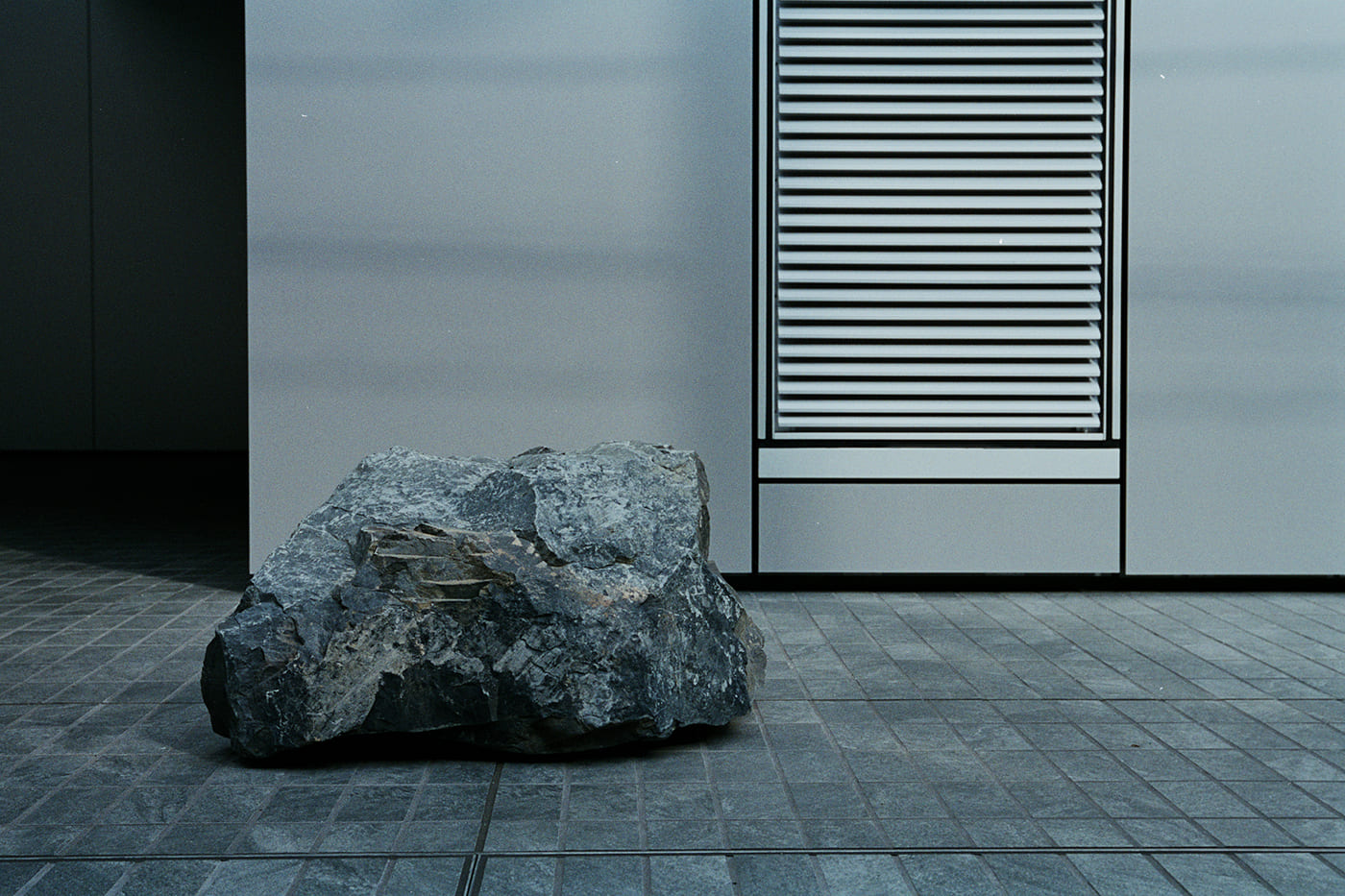
Yamaguchi: When we went to Katsura Imperial Villa, we saw how the site was surrounded by a low bamboo fence. The inside is a protected space where the Emperor once lived, but there is a bamboo forest, then a bamboo fence where a public road runs naturally right next to it. Referencing such a scenery, I tried to connect the site to the surrounding space by creating the least boundaries. By not creating a boundary or a clear prohibited zone, I thought it would feel better to have a loose connection between the inside of the site and the public space outside. So, instead of building a fence, I imagined putting up a spiritual barrier around it. That is why we have the pine tree and stone wall on the southeast corner near the main entrance, while a large rock and bamboo grove is on the northeast corner.
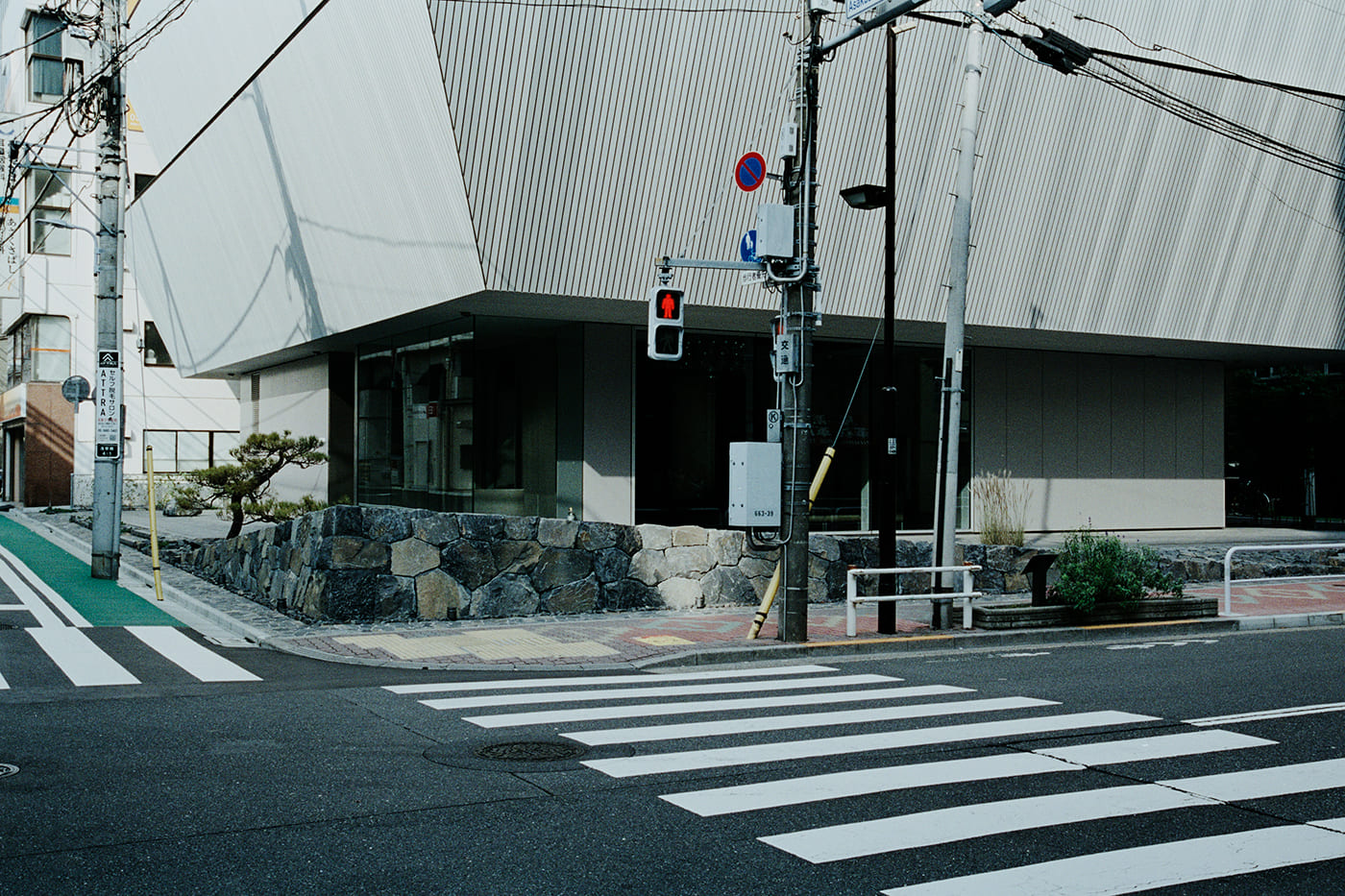
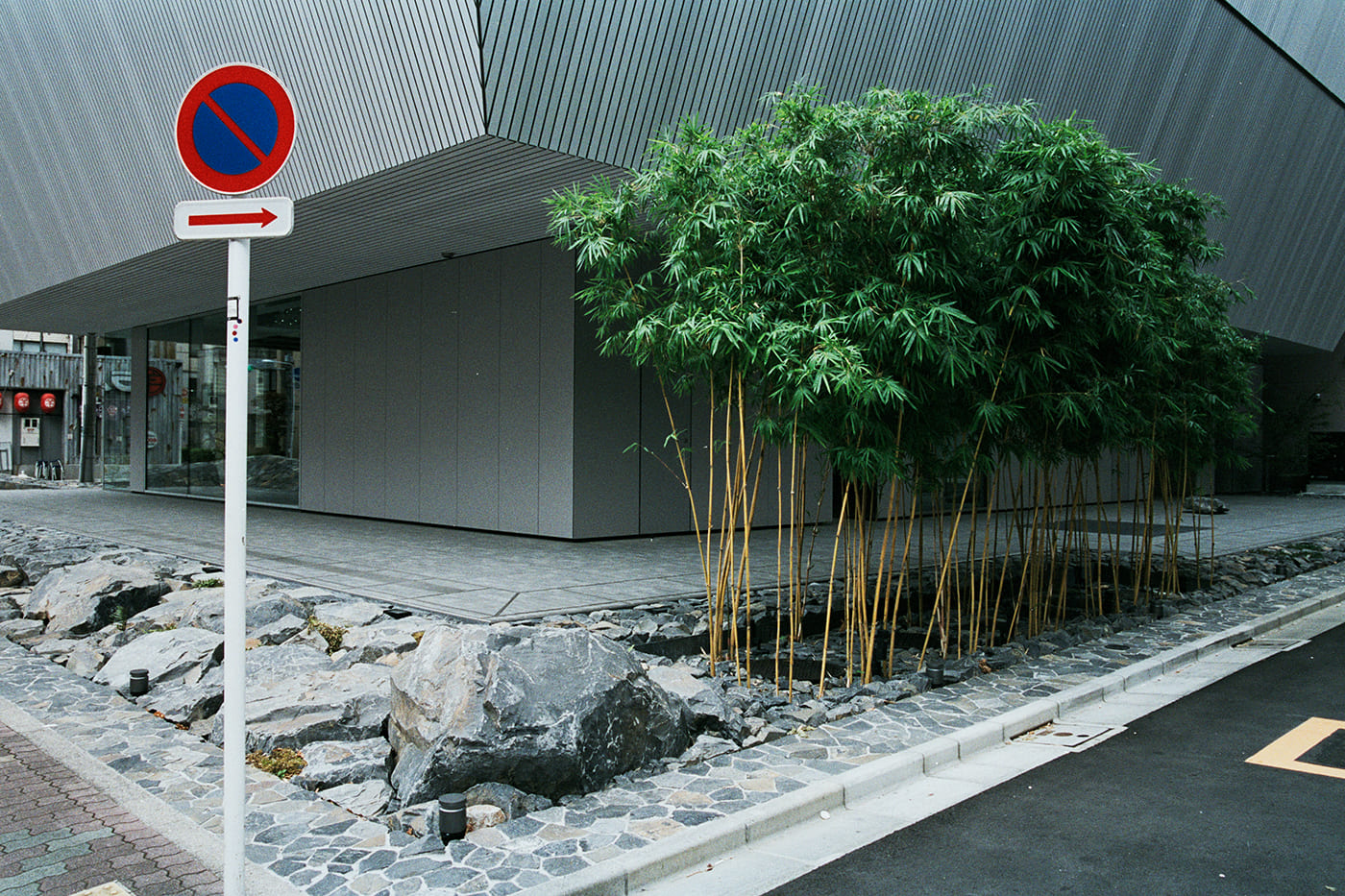
Yamaguchi: While we placed rugged rocks on the outermost part connecting to the local streets, we covered the inner part with flat tiles. Rather than abruptly neighboring the inside and outside, we created a buffer zone to gently connect them. The colors are also selected to create a gradation of grey. The building adopts a seismic isolation structure, which prevents it from shaking as much in the event of a large earthquake. However, because the area around the building would still shake, the outermost part of the flat tile is left movable to absorb the motion. The conventional option would be to emphasize the range of movement by adding differences in height or materials. However, we encapsulated the functionality within the material because we thought highlighting the function would add another piece of information.
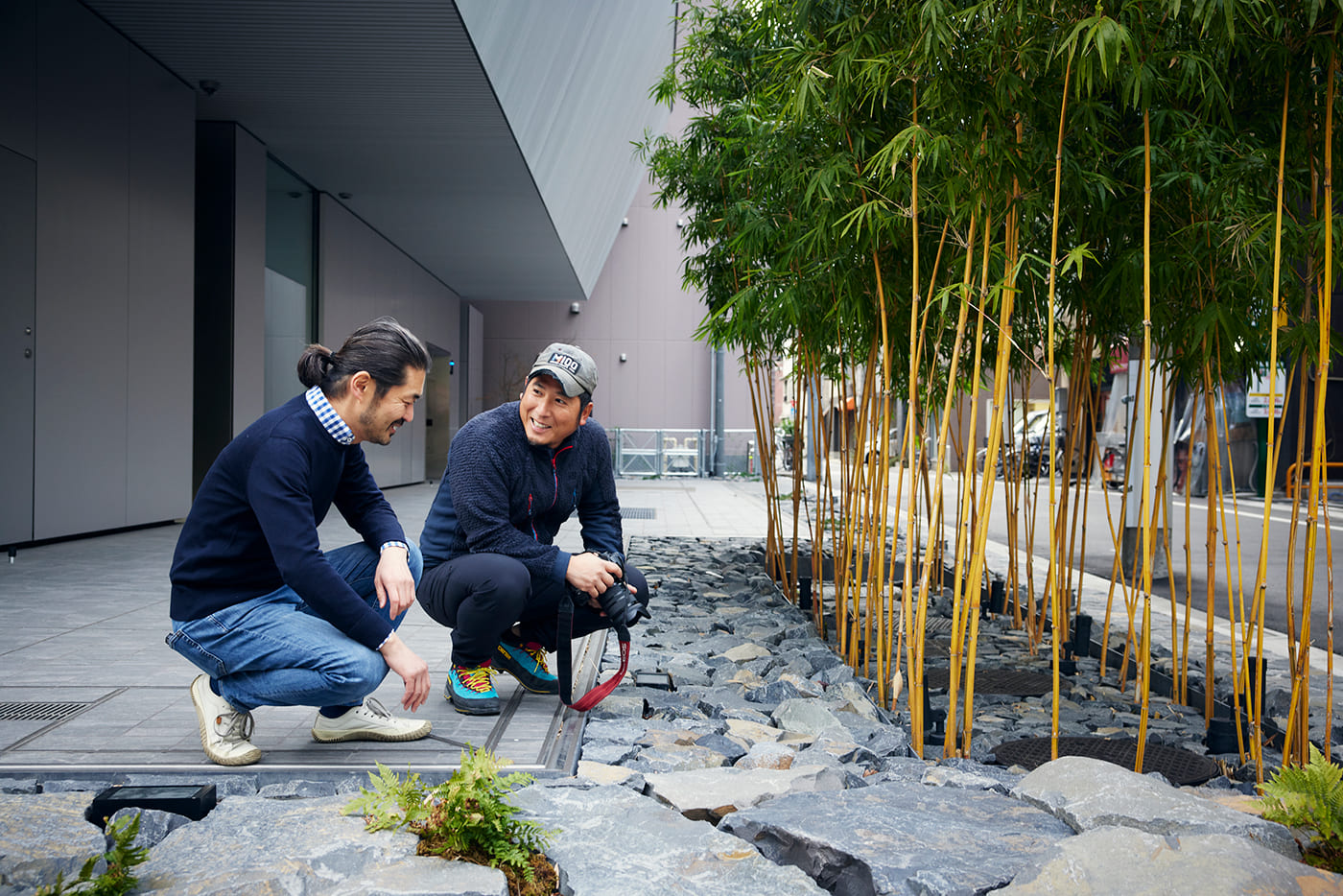
Yamaguchi: Also, instead of creating a large building using large modules, we tried to imitate how natural objects are made, and collect smaller pieces to make large-scale things. The exterior walls are made of custom-made molded thin aluminum panels that are installed one by one on-site by hand. So, it makes me happy to see the collection of details like floorings, walls, and plants captured in the photographs.
So, in that sense, you couldn’t have created this gradation using plants with rounder leaves?
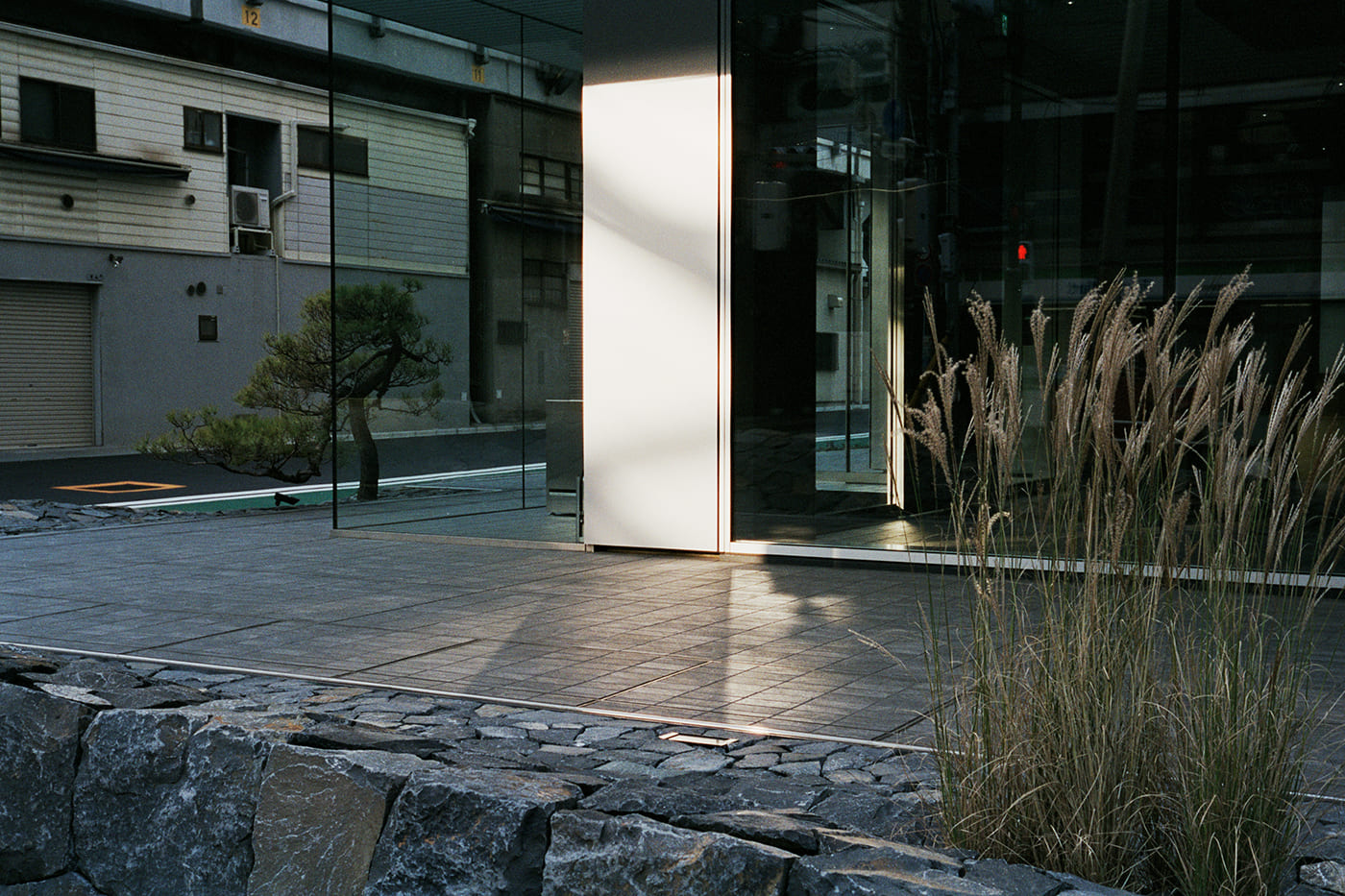
Yamaguchi: That’s right. We selected plants with long slender leaves, such as pine, bamboo, silver grass, and juniper.s
Kumon: I see. When I took the close-up pictures of the materials, I felt they reflected the Yamaguchi style. No matter how many elements are involved, I always hope that Mr. Yamaguchi’s ideas will take shape. We ended up with so many full-shot photos, but I think it is because I like the ones that give a sense of the city.
Yamaguchi: The one with the silver grass in the foreground and the pine tree in the back is the photo that makes me happy. Silver grass is considered weeds and rarely makes it in the same frame as pine, which is considered to have a formal status in Japanese gardens.
Experiencing the architecture
Kumon: When I photographed on a Sunday morning, I saw quite a few people walking past. However, when I finally selected the photos, I preferred the ones without people. When there are people, you start to see a narrative or a protagonist. Instead, it’s enough to imagine what kind of a person lives there. The scenery becomes a scenery by including people, but for this particular project, I felt otherwise.
Yamaguchi: The same can be said about the previous photographs from the Japanese gardens. Maybe it is about having one too many pieces of information. The image of people is so strong that it could add noise when we try to observe neighboring textures.
Kumon: That being said, I have to say the presence of Ramuchan (a grilled mutton restaurant) is astounding (laughs). Architects usually would hate it.
Yamaguchi: I might have felt that way when I was younger, but now I feel like the gray color of the facade is matching.
Kumon: The lines on the walls are also matching. They look quite similar actually.
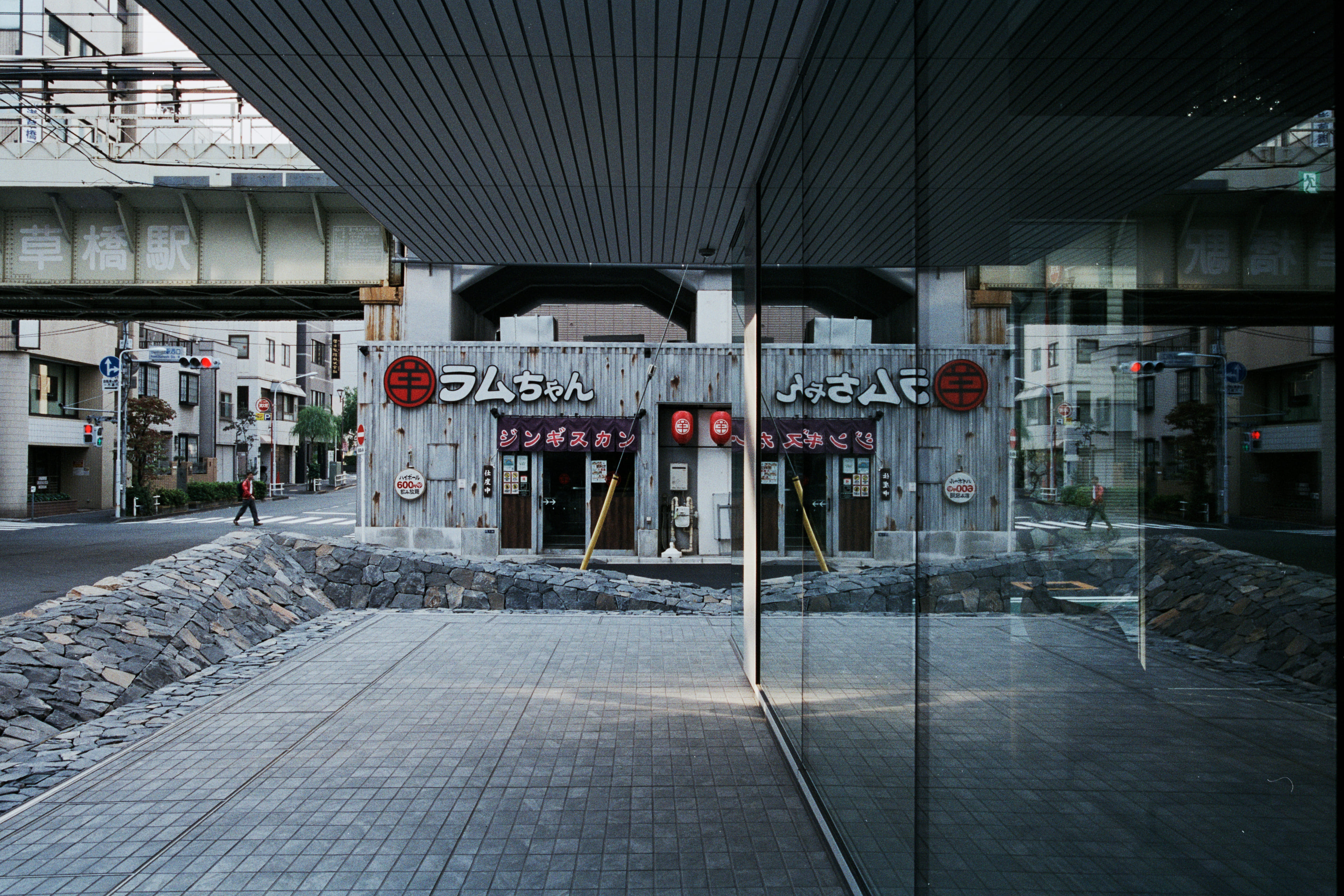
Yamaguchi: One doesn’t exist for the other to stand out. I like this situation where the hierarchy vanishes between the architecture, the surrounding stores, and the electricity poles.
You started designing the MONOSPINAL project in 2018, and the Shakkei—Neighbouring Textures project in 2019. From what you’ve mentioned earlier, it is apparent that the two projects have influenced each other in their progress. Do you agree?
Yamaguchi: Yes, I do think so. We go back and forth between the overview and the details, but we never know how we could experience the resulting space. Of course, we use physical models and 3D models to help our imagination as much as we can. But when I see Mr. Kumon’s photos, I find myself discovering, “Ah, so this is how it’s perceived.” Then, I receive the framed images as input to my head and imagine what it would be like if I applied that somewhere else. So the project definitely influences how I see things.
Kumon: In my case, I basically hate location scouting. I believe that there is nothing better than the moment you see something for the first time. I obviously do plan beforehand to some extent, but I always want to capture that fresh feeling with my camera. So, I think that through this project, I am learning to let go of my preconceptions. For example, the presence of mountains such as Mount Hiei is often referred to as shakkei. In reality, however, you can’t really see them that well. MONOSPINAL is a unique building, but from the perspective of those who work or live there, the building is essentially playing a supporting role.
Yamaguchi: I see, so you’re photographing from the inhabitants’ point of view.
Kumon: For the people who live here, the space is captured in a certain way: “There’s something nice about this scenery on the way to school.” And I believe we should be speaking from their perspective as someone to view architecture. To do that, my approach is to let go of my desire to see things in a certain way and to focus on fresh sensations.
I started thinking this way when I realized I couldn’t control Japanese gardens. Trying to capture a perfect garden would only impose strict conditions on myself. At first, I was saying to Mr. Yamaguchi things like, “Shouldn’t we be photographing in the morning light?” or “It would look better if it was snowing.” However, I realized my job is not to take the best conventional shot. Now I feel it’s important to go during normal visiting hours for tourists and see it from the perspective of someone who lives or visits there.
Yamaguchi: I totally agree. Although architecture has its requirements and concepts, they don’t matter to the passers-by. For instance, I could’ve created a design that visualizes the response to the elevated railway. But if it stands out too much, they would feel as if they are being constantly explained every time they pass by the street. Therefore, I don’t think the value of a building is in its concept nor the embodiment of it, but rather in the experience that the building delivers to the people who live there by continuing to stand in a space over a long period.
Mr. Kumon’s photographs are truly the manifestation of how he experienced the buildings. So, I believe the photos translate what would’ve been an explanation of the concept if it were up to me into an experience.
Kumon: In terms of letting viewers discover, the same goes for photographs. For that reason, I want to stay as neutral as possible. I think it’s important to put aside my preparation and focus on what I find interesting at each moment.
Hypotheses on Japanese culture
This project originally started from your interest in Japanese gardens. After four years, what are your thoughts on Japanese culture?
Yamaguchi:
When I appreciate a Japanese garden in some way, I am interested in finding out the main structure or elements that could recreate that feeling. After all, an architect is a profession of creativity. Many continental cultures, including the European ones, often have clear definitions and rules for certain styles, but Japanese culture is often ambiguous. I think that is related to how I can’t quite nail the explanation of my works, and I think there may be some similar reasons.
In continents, countries share borders, which inevitably leads to building higher walls to prevent attacks. That’s why I think it is quintessentially Japanese, or archipelagic perhaps, to be able to put two different things next to each other. This is how I am trying to figure out what I like and what’s behind those feelings.
Kumon: Even though Japanese traditional culture could feel intimidating with its formality, I’ve recently realized it has quite a tolerance. At MONOSPINAL, the Japanese garden-style bamboo fences and gravel finish fit naturally, while the exterior form somewhat resembles a five-storied pagoda. As opposed to incorporating a fraction of Japanese culture, such as creating one Japanese-style room in a Western-style house, I think it is hard to find experiments that explore the Japanese way of seeing things and Japanese sensibilities.
Yamaguchi: We have elements such as tatami mats and shoji screens in Japanese architecture. However, from a Japanese point of view, it is questionable whether simply adopting shoji screens would make something Japanese style. I believe that kind of ambiguity makes the Japanese cultural discourse difficult. So, I used pine and bamboo in this case for clarity, but if they could embody the concept of Neighbouring Textures, I could even be using tropical plants. I’m at the point where I’m figuring things out like this through trial and error. Whether such a perspective embodies Japanese culture is merely my hypothesis.
December 27, 2023